
.png)
The forest was glittering and it wasn't magic...

Let me tell you about a new friend of mine.
He's the kind that grabs your attention without even trying and is one heck of a host!
I love simple things, don't get me wrong, but it takes something amazing to really knock my socks off their hinges.
This fella has done that quite a bit already this spring.
Sure, I knew of him when I was in the South but this version I'm seeing in the north is pure magic.
I'm talking about the birch tree!

Yes, I've been swooning over a tree.
This isn’t just any tree though. Let me introduce you to the northern version and why it has been impressing me every time I go into the woods lately.
In the south, where I'm from, it is mainly river birch that is common.
Yes, a birch is a birch, and they are incredible either way but, 'knock my socks off their hinges' impressive didn’t happen until we moved to New York.
Since winter has been thawing we have been going on hikes in the Adirondacks.
We are still new here, we didn't move to this area from Ohio until Halloween, we’ve been experiencing a lot of these things for the first time.
Being that I'm originally from Georgia, I thought Ohio was pretty far north. Now that we are living 15 minutes from the Canadian border it feels like a whole new world when it comes to foraging and exploring the woods.
The first spring weekend we went on a hike, I noticed the difference as soon as we got out of the jeep.
The gold caught my eye
I thought maybe it was because I had been cooped up a lot over winter and the sun was out which has been rare lately, but as we got deeper into the trail I noticed it appearing more and more.
An undeniable gold shimmer moved through the path, creating a magical shine that couldn’t be missed.
I looked closer and noticed it was coming from birch trees!
The birch trees I was familiar with were always gray and cold looking, even in the middle of summer with the sun blazing down, I never experienced the gold shine.
I didn’t even notice it here, in the winter, when we did a few short trails.
This gold awakens something inside of you.
It’s almost like this gold arrived for opening day of the warmer hiking season.
Birch isn’t flashy in a “look at me, I want to be noticed” kind of way.
It’s more like the forest is winking at you for paying attention to the little details.
Even the leaves covering the forest floor have a shimmer when the sun catches them.
It makes the whole hike feel like a fairy tale.
So, why are these birch trees different from the birch trees I was familiar with?
I was intrigued so of course I had to do research. I already knew there were a lot of types of birch, there are roughly 60 birch species worldwide. What I didn't realize is that botanists can't really make up their minds about some of the species and subspecies of birch, so the number fluctuates from time to time.
Not all birch trees have the same vibe,
more specifically they don't have the same light reflection patterns.
-White/paper birches reflect light like parchment would. Almost like a brighter light.
-Yellow birch catches and reflects light in a warm gold way that feels almost metallic in spring sunlight,
as if the forest is performing the ultimate magic show.
-Southern birches, they always seem more earthy than luminous.
They appear more flat and not as reflective.
There is so much variety between them all because of different oils and resins in the bark, different types of bark layers, and reflective compounds in some types of barks.
Some birch varieties don’t even have flat bark like most trees.
Their bark layers like a curl, similar to parchment paper.

Just like members of the same human family can often have entirely different personalities,
the same is true for plants, and it is especially noticeable with birch trees.
The birch tree isn't just a tree;
it is a whole entire gathering place and it really knows how to be quite the impressive host!
Some of the fungi I’ve become fascinated with, especially chaga, are far more associated with northern cold-climate birch forests.
Many of the fungi I’ve become fascinated with are far more associated with northern birch forests
than southern ones. It is even a very rare occasion in Ohio. Chaga loves the cold and specific types of birch.
Tinder fungus is a bit of a multi party attende

and loves cold weather birch but will also show up on beech trees.
Birch Mazegill
is another fungus, this one has pores on the underside that look like a maze. It thrives in cold climates and especially loves dead birch branches and logs.
Birch polypore
is another fungus that on the guest list, it thrives on cold climate birch trees.
It specifically loves the paper birch and yellow birch which is found in the northern climates.
While it can technically be found in the warmer southern states it is rare.
The northern climate offers
a slower decomposing environment. The ground in the woods around here, in the Adirondacks are extremely thick with layers and layers of decaying forest which also contributes to a lot of the variations of plants, fungi, and other interesting things while hiking or foraging.
Some guests show up to the party without being prominent on the guest list.
Usnea and other lichens show up where birch thrive but they aren't exactly dependent on birch. They bring medicinal properties, well rounded history, and ancient knowledge without completely crashing the party.
Birch isn’t only an impressive host, it is also a whole entire medicine cabinet.
Paper birch (Betula papyrifera) is a North American birch variety known for its distinctive bright white bark that peels in papery strips. It is really fascinating finding these paper rolls around the forest floor. Almost like nature left sheets of a journal behind.
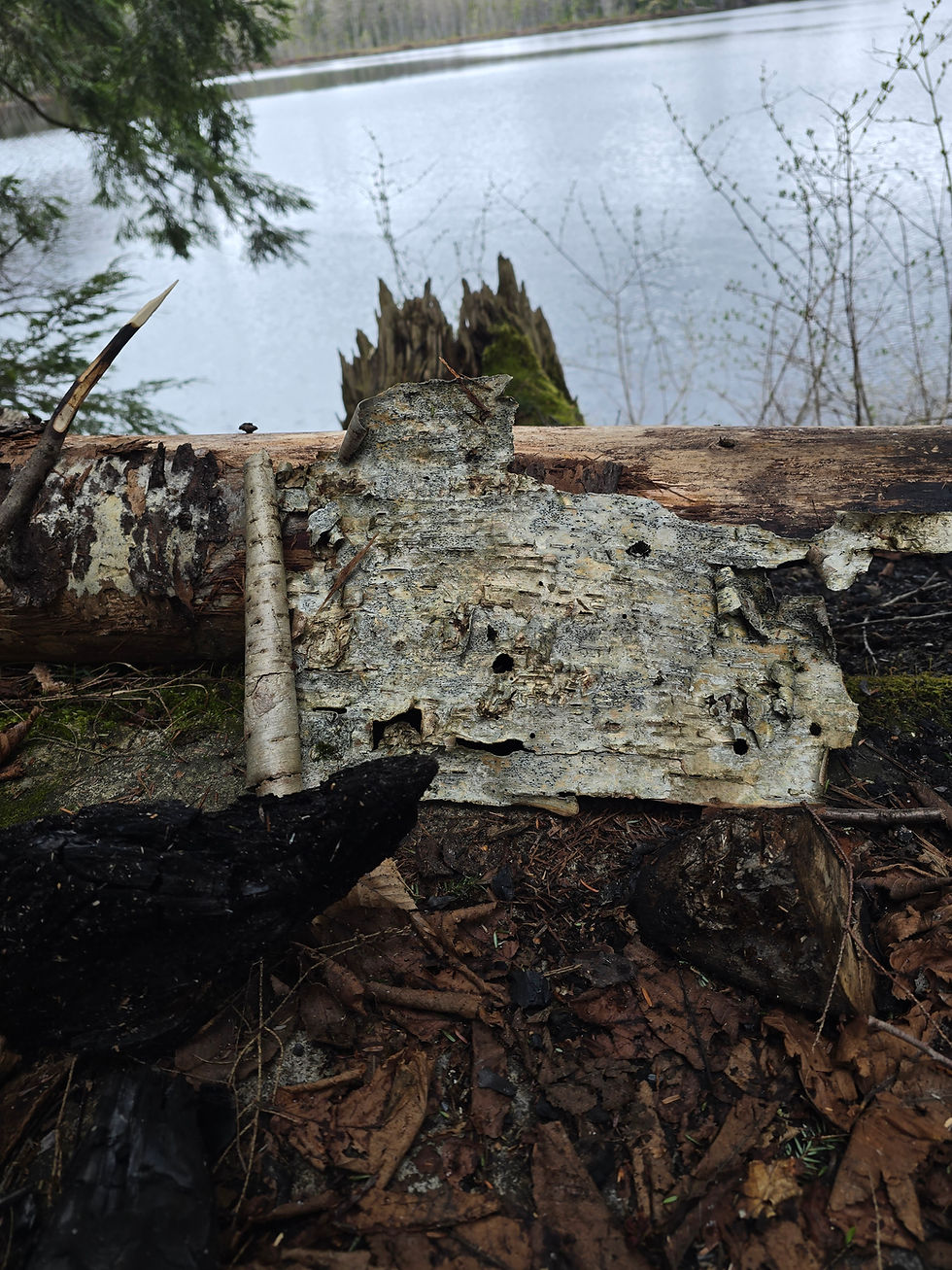
These trees have been useful for making canoes, firewood, and for various landscaping purposes.
Before modern pharmacies paper birch was basically a growing first aid kit. Indigenous communities used this tree to make waterproof containers, wound coverings, medicinal tea, and even emergency fire starter. Some birch species contain compounds historically associated with pain-relief traditions.
People have been using different types of birch trees for anything from
Canoes to mineral water, birch sap, even making birch tar.
Birch tar is actually one of humanity’s oldest medicinal adhesives.
Birch bark was heated and turned into a black sticky tar, this tar was then used for sealing wounds, waterproofing, attaching tools, and antimicrobial applications. Archeologists have found evidence of birch tar use going back tens of thousands of years.

Stinky breath?
Yellow birch was used as a trail snack and also for a mouth freshener. Yellow birch has a slight wintergreen flavor. People would chew on twigs to freshen their breath and as a snack when on long hikes.
The ancient ice-man
When Otzi, a 5,000 year old preserved man was discovered in the Alps, he had a pouch with birch polypore. He may have been using it for a fire starter, parasites, wound care, or antimicrobial purposes. That little fungal pouch is one of the oldest known examples of humans intentionally transporting medicinal fungi.

Nature lingers in the shadows.
It isn’t exact, and it definitely does not follow our rules. It almost always leaves room for exceptions. So when it comes to the wild, think in patterns, not absolutes.
The more I learn
about birch forests, fungi, old traditions, and the way people used to live with nature instead of fighting against it, the more I realize where a lot of the inspiration for The Sigh of Relief Method came from.
It really all stems from slowing down, paying attention, eating real food, getting outside, and noticing nature has been offering support for us this whole time.
Honestly, birch trees feel like the perfect symbol for that. They are quietly impressive and far more useful than most people realize especially in today's time.


Comments